Compound Interest Explained: How Your Money Can Work Harder Than You Do
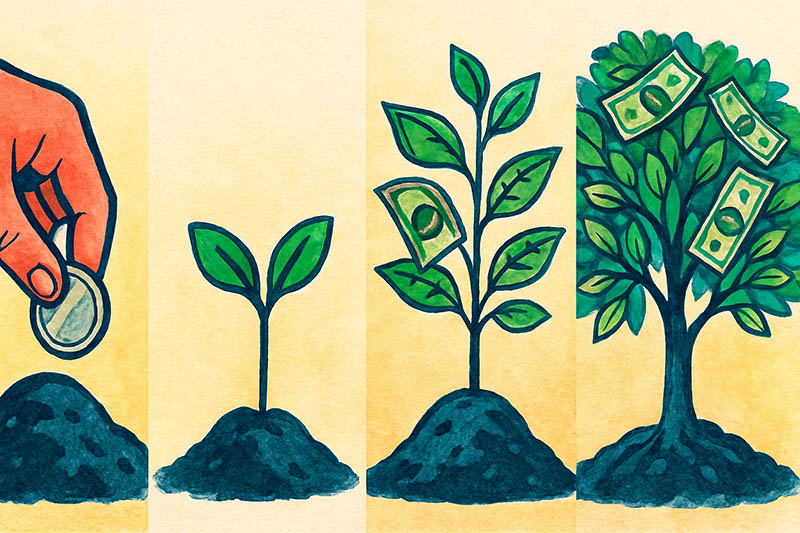
Your money can work harder than you do – but only if you let it.
Meet Sarah and Mike. They’re both 25, earn the same salary, and start saving $200 every month. Sarah puts her money in an account that earns compound interest. Mike sticks with simple interest. Fast forward 40 years. Sarah retires with over $500,000. Mike has less than half that amount. Same money, same timeframe – completely different results.
What made the difference? Compound interest.
By the end of this post, you’ll understand exactly how compound interest works and know the simple steps to make it work for you. We’ll break down the math, share real examples, and show you where to get started today. No confusing jargon. No complicated formulas. Just the clear truth about how money makes money.
Ready to discover the closest thing to magic in personal finance?
Key Takeaways
- Compound interest is interest on interest – you earn money on both your original savings and the interest you’ve already earned
- Time is more powerful than amount – starting early with small amounts beats starting late with large amounts
- Your money works 24/7 – compound interest grows your wealth while you sleep, work, and play
- Every dollar counts – even $25 per month can become substantial wealth over decades
- Consistency beats perfection – regular saving with modest returns outperforms trying to time the market
What Is Compound Interest?
Compound interest is when you earn interest on both the money you’ve saved and the interest you earn. Think of it this way: your original money earns interest. Then that interest starts earning its own interest. And that interest earns interest too.
It’s like a snowball rolling downhill. It starts small but gets bigger and faster as it picks up more snow. Your money works the same way. The longer it rolls, the bigger it gets.
Compound Interest Calculator
Growth Visualization

Simple Interest vs. Compound Interest: The Big Difference
The difference between simple and compound interest is huge. Let's prove it with real numbers.
Imagine you invest $5,000 at 6% interest for 25 years. Here's what happens with each type of interest:
Simple Interest: You earn 6% on your original $5,000 every year. That's $300 per year, every year. After 25 years, you've earned $7,500 in interest. Your total is $12,500.
Compound Interest: You earn 6% on your growing balance each year. After 25 years, your total is $21,911. That's $9,411 more than simple interest.
Same starting amount. Same interest rate. Same timeframe. But compound interest gives you nearly twice as much money.
Here's why this happens. With simple interest, your interest never grows. You always earn $300 per year because it's always calculated on just your original $5,000.
With compound interest, your interest payment grows every year. In year 10, you're earning $447 in interest. By year 20, you're earning $669 per year. In the final year, you earn $978 in interest - more than three times your simple interest payment.
This is the power of compound interest. Your money doesn't just grow. It grows faster and faster over time.
The math works because compound interest includes "interest on interest." Every dollar of interest you earn becomes part of your principal. Next year, that dollar earns its own interest. The year after that, the interest on that dollar earns interest too.
It sounds small at first. But over decades, this effect becomes massive.
The Power of Time: Why Starting Early Changes Everything
Time is the secret ingredient that makes compound interest powerful. The earlier you start, the less you need to save to reach the same goal.
Let's look at three friends who want to save for retirement:
Sarah starts saving at 25: She saves $500 per month for 40 years. Assuming 7% annual returns, she has $1,342,000 at retirement.
Mike starts saving at 35: He saves $500 per month for 30 years. With the same 7% returns, he has $593,000 at retirement.
Emily starts saving at 45: She saves $500 per month for 20 years. She ends up with $230,000.
All three saved the same amount each month. But Sarah, who started just 10 years earlier than Mike, ends up with more than twice as much money. Mike, who started 10 years earlier than Emily, has nearly three times more.
This is what financial experts call "the lost decade effect." Every 10 years you wait costs hundreds of thousands of dollars in potential growth.
Here's an even more shocking example. If a 25-year-old started investing $200 per month and we're assuming a 6% return, by the time they turned 65, they'd have a nest egg worth $393,700. But if they'd waited until 35 to start saving $200 a month, even with the same rate of return, they'd end up with just about half that — $201,100 — by age 65.
Why does starting early make such a huge difference? Because compound interest needs time to work its magic. In the early years, your returns are small. But those small returns earn their own returns. And those returns earn returns. By year 30, your money is growing faster than you can possibly save.
If you start late, you can still benefit from compound interest. But you'll need to save more to catch up. Someone who starts saving at 45 might need to save $1,200 per month to match what someone saving $400 per month from age 25 accumulates.
The lesson is clear: time beats timing. You don't need to wait for the perfect moment or the perfect amount. Start now, even if it's just $25 per month.
Real Compound Interest Examples That Will Amaze You
Let's look at some real examples that show the incredible power of compound interest over time.
The College Fund Example: When your child is born, you invest $5,000 in a college fund. You never add another penny. Here's what happens by the time they turn 18:
- At 5% annual returns: $12,166
- At 7% annual returns: $16,879
- At 10% annual returns: $27,735
That one-time $5,000 investment could pay for a significant chunk of college costs.
The Coffee Shop Investment: Instead of buying a $5 coffee every workday, you invest that money. Over 30 years at 8% returns, your daily coffee money grows to $351,000. That's a lot of lattes.
The Retirement Reality Check: Here's what $200 per month grows to over different timeframes at 8% annual returns:
- Save from age 25-65 (40 years): $1,295,000
- Save from age 35-65 (30 years): $525,000
- Save from age 45-65 (20 years): $175,000
Same monthly amount, but starting 20 years earlier gives you seven times more money.
The Millionaire Janitor: This isn't a made-up story. Ronald Read was a janitor who never earned more than $20,000 per year. When he died at age 92, he left behind $8 million. How? He bought dividend-paying stocks and reinvested every penny for decades. Compound interest turned his modest income into generational wealth.
These examples show why compound interest is often called the eighth wonder of the world. It can turn ordinary savings into extraordinary wealth, but only if you give it enough time.
The key insight is this: wealth isn't about how much you earn. It's about how much you save and how long you let compound interest work.
Where to Find Compound Interest
Now that you understand how powerful compound interest can be, where can you actually find it? Here are the best places to put your money to work:
High-Yield Savings Accounts: These pay compound interest on your deposits. The best accounts currently pay around 4-5% annually. Your interest compounds daily or monthly, which means you earn interest on your interest very quickly.
Certificates of Deposit (CDs): Banks pay you a fixed interest rate for agreeing to leave your money untouched for a set period. CDs usually offer higher rates than savings accounts. Interest earned on money market accounts is usually compounded daily and deposited monthly.
Investment Accounts: This is where compound interest really shines. When you invest in stocks, bonds, or funds, your returns compound over time. When you reinvest earnings received from stocks and mutual funds, you can take advantage of compounding.
401(k) and IRA Accounts: These retirement accounts use compound interest to grow your savings tax-free or tax-deferred. Many employers even match your contributions, which supercharges your compound growth.
Index Funds: These track the stock market and historically return about 10% annually over long periods. Your dividends get reinvested automatically, creating compound growth.
Bond Funds: These provide steadier returns than stocks, usually around 3-6% annually. The interest compounds as you reinvest your earnings.
What should you avoid? Any account with high fees that eat into your returns. A 1% annual fee might not sound like much, but over 30 years, it can cost you tens of thousands in compound growth.
Also avoid keeping large amounts in regular checking accounts that pay little to no interest. Every day your money sits there earning nothing is a lost opportunity for compound growth.
Common Compound Interest Mistakes
Even people who understand compound interest make costly mistakes. Here are the big ones to avoid:
Mistake #1: Waiting to Start The biggest mistake is thinking "I'll start investing when I make more money." Every little bit helps in the long run. If a 25-year-old started investing $200 per month and we're assuming a 6% return, by the time they turned 65, they'd have a nest egg worth $393,700 compared to much less if they waited.
Starting with $50 per month is infinitely better than starting with $0. You can always increase your savings later as your income grows.
Mistake #2: Not Reinvesting Returns Some people take their investment gains and spend them. This kills compound growth. If you earned $500 in dividends and spent it on vacation, that money can't compound for the next 20 years. Over time, that $500 could have grown to thousands.
Always reinvest your returns unless you absolutely need the money. Most investment accounts can do this automatically.
Mistake #3: Focusing Only on Interest Rate A high interest rate means nothing if you can't stick with it. A 5% return that you maintain for 30 years beats a 12% return that you abandon after 5 years. Consistency and time matter more than finding the perfect rate.
Mistake #4: Letting Fees Eat Your Returns Investment fees compound too, but in reverse. A 1% annual fee on a $100,000 account costs $1,000 per year. But as your investments grow, so too will your annual costs from fees.
Always read the fine print on investment accounts. Look for low-fee index funds and high-yield accounts with minimal charges.
Mistake #5: Trying to Time the Market Some people wait for the "perfect" time to invest. They want to buy when the market is low and sell when it's high. But studies show that time in the market beats timing the market.
You might've heard the saying: "It's not about timing the market. It's about time in the market." That's because time fuels the potential power of compounding.
How to Get Started with Compound Interest Today
Ready to put compound interest to work? Here's your step-by-step action plan:
Step 1: Open a High-Yield Savings Account Start with at least $100 if you can. Look for accounts paying 4% or higher. Online banks usually offer the best rates. This gives you a safe place to earn compound interest while you learn about investing.
Step 2: Start a Retirement Account If your employer offers a 401(k) with matching, start there. Free money from your employer compounds too. If not, open an IRA. You can start with as little as $25 per month.
Step 3: Choose Simple Investments For beginners, target-date funds are perfect. They automatically adjust your investment mix as you get older. Index funds that track the whole stock market are another great choice.
Step 4: Automate Everything Set up automatic transfers from your checking account to your savings and investment accounts. Pay yourself first, before you pay bills or spend money on entertainment.
Start small if you need to. Even $25 per month is a victory. You can increase the amount as you get comfortable and as your income grows.
Step 5: Use Compound Interest Calculators Play around with online calculators to see how your money could grow. Try different scenarios - what happens if you save $100 vs $200 per month? What if you get 6% returns vs 8%?
These calculators help you set realistic goals and stay motivated when you see the long-term potential.
Step 6: Track Your Progress Check your accounts monthly, but don't obsess over daily changes. Focus on the long-term trend. Celebrate milestones like your first $1,000 or when your investment returns exceed your monthly contributions.
Remember: the hardest part is starting. Once you automate your savings and investing, compound interest works 24/7 without any effort from you.
Conclusion
Compound interest is simple: it's interest on interest. But this simple concept can transform your financial future.
Here's what you need to remember:
Time is your most powerful tool. The earlier you start, the less you need to save to reach your goals. Even small amounts can grow into substantial wealth over decades.
Consistency beats perfection. You don't need the highest interest rate or the perfect investment. You need to start now and stick with it.
Your money can work harder than you do. While you sleep, your invested money earns returns. Those returns earn their own returns. Year after year, this compounds into serious wealth.
Every dollar matters. That $5 coffee, the $50 monthly subscription you forgot about, or the $200 you might save on your phone bill - all of these can become thousands of dollars through compound interest.
Your next step is simple: choose one account to open this week. Set up one automatic transfer. Calculate your own compound interest scenario using an online calculator.
The best time to start was 10 years ago. The second-best time is today.
Compound interest never sleeps. It works nights, weekends, and holidays. It doesn't take sick days or go on vacation. It just quietly, steadily grows your wealth.
Your future self will thank you for starting now. Even if you start with just $25 per month, you're beginning a journey that could change your life.
Stop waiting for the perfect moment. Start small, start simple, but start today. Let compound interest work its magic, and watch your money grow into something bigger than you ever imagined possible.