What’s the Difference Between APR and APY?
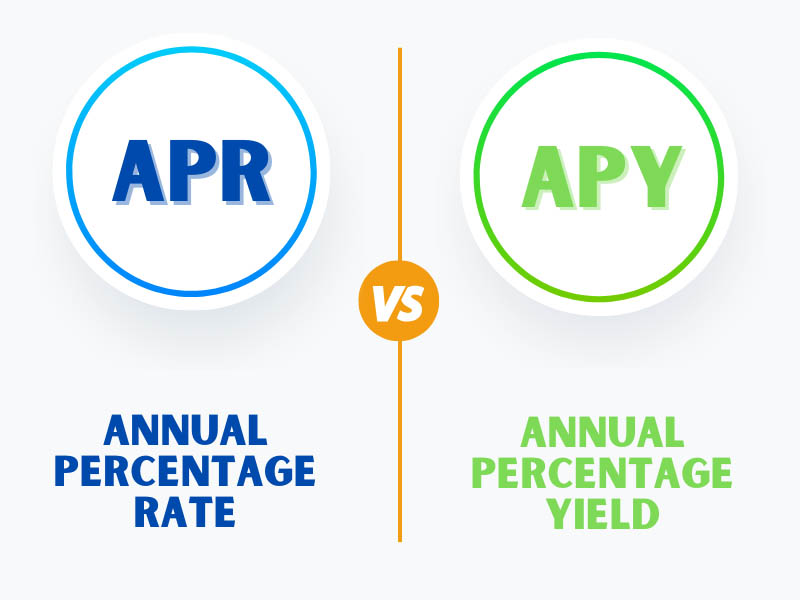
You’ll see these two acronyms show up everywhere in personal finance. Credit card advertisements will display their APR (Annual Percentage Rate). Savings accounts promote their APY (Annual Percentage Yield). Both involve interest rates, but they work in opposite directions for your money.
Understanding the difference between the two – and how they’re both calculated – can often help you make smarter financial decisions.
Here’s a breakdown, without the fluff.
Key Takeaways
Before we break this down, here’s what you need to know:
- APR shows what you pay – It’s the annual cost of borrowing money on loans and credit cards
- APY shows what you earn – It’s the annual return on your savings and investments
- APY includes compound interest – This makes it higher than a simple interest rate
- APR includes fees, if any– Monthly or annual fees and closing costs
- Lower APR is better for borrowing – You’ll pay less in interest and fees
- Higher APY is better for saving – Your money grows faster
- Both help you compare – They standardize different products so you can shop around with confidence
Think of APR as money flowing out of your pocket. APY is money flowing into your account.
What APR Actually Means
APR stands for Annual Percentage Rate. It tells you the total yearly cost of borrowing money.
When you take out a loan or use a credit card, you don’t just pay the basic interest rate. You might also pay origination fees, closing costs, annual fees, or other charges. APR bundles all these costs into one number so you can compare different lenders fairly.
That does not mean those fees are “hidden”. In fact it means the opposite. By law, lenders are required to advertise the total cost of their loan products as an APR, so you can compare options at a glance.
For credit cards, the APR and interest rate are usually the same because most fees aren’t included in the calculation. But for mortgages, auto loans, and personal loans, the APR is often higher than the advertised interest rate.
APR uses simple interest in most cases. This means you pay interest only on the original amount you borrowed, not on accumulated interest. The exception is credit cards – if you don’t pay your full balance, interest compounds daily, but credit card APRs don’t reflect this compounding.
Right now in 2025, average credit card APRs hover around 20-24%. Mortgage rates vary but typically range from 6-8% APR depending on your credit score and the loan term.
What this means for you: Always compare APRs, not just interest rates, when shopping for loans. The lowest APR will cost you the least over time.
What APY Actually Means
APY stands for Annual Percentage Yield. It shows how much your money will grow in one year, including the power of compound interest.
Unlike APR, APY accounts for how often your interest compounds. Compound interest means you earn interest not just on your original deposit, but also on previously earned interest. It’s like interest earning interest.
Most savings accounts compound daily or monthly. This frequent compounding creates a snowball effect that makes your money grow faster than simple interest would suggest.
Banks are required by law to show APY on deposit accounts. This gives you an apples-to-apples comparison between different savings products, even if they compound interest at different frequencies.
The current landscape in 2025 shows the national average savings account APY at about 0.59%. But high-yield savings accounts offer APYs of 4% or higher. Some online banks and credit unions are pushing rates above 4.5%.
In the crypto world, APY is commonly used for staking rewards and decentralized finance yields. These can range from 2% to 20% or more, though they come with additional risks.
What this means for you: Focus on APY, not just the interest rate, when choosing where to save or invest. Higher compounding frequency generally means better returns.
The One Key Difference That Matters
Here’s the big distinction: APY includes compound interest, while APR typically doesn’t.
Compound interest is when your earnings start earning money too. Let’s say you have $1,000 in a savings account with 5% APY that compounds monthly. Each month, you earn interest on your original $1,000 plus any interest you’ve already earned. By the end of the year, you’ll have more than the $50 you’d get from simple interest.
The frequency of compounding makes a difference. Daily compounding will earn you slightly more than monthly compounding, which earns more than annual compounding.
For the same base interest rate, APY will always be higher than APR (unless there’s no compounding, in which case they’re equal). A 5% interest rate compounded daily gives you an APY of about 5.13%.
This difference might seem small, but it adds up over time and with larger amounts of money. On a $10,000 balance, that extra 0.13% is worth $13 per year. Over 10 years, the compounding effect becomes much more significant.
What this means for you: The compound interest factor in APY is why time is your friend when saving money. The longer you leave money in an account with good APY, the more powerful compounding becomes.
When APR Applies to Your Money
APR shows up when you’re borrowing money. Here’s where you’ll see it:
Credit cards use APR to show what you’ll pay if you carry a balance. Most cards have different APRs for purchases, balance transfers, and cash advances. The purchase APR is what most people focus on.
Mortgages display APR to help you compare lenders. A 7% interest rate might have a 7.2% APR once you factor in closing costs and fees. This helps you see the true cost of the loan.
Auto loans work similarly. The APR includes the interest rate plus any origination fees or other loan costs.
Personal loans often have APRs ranging from about 6% for excellent credit to 36% for poor credit. The APR helps you understand the total borrowing cost.
When shopping for any loan, focus on APR rather than just the interest rate. The loan with the lowest APR will cost you the least money over the life of the loan.
Also pay attention to whether the APR is fixed or variable. Fixed APRs stay the same, while variable APRs can change based on market conditions.
What this means for you: Lower APR equals lower cost to you. Always compare APRs when loan shopping, and consider the total cost over the full loan term.
When APY Applies to Your Money
APY shows up when you’re earning money on deposits or investments. Here’s where it matters:
Savings accounts use APY to show your earning potential. High-yield savings accounts currently offer APYs of 4-5%, compared to the 0.59% national average.
Certificates of deposit (CDs) lock in an APY for a specific term. Right now, 1-year CDs might offer 4.5% APY, while 5-year CDs could offer slightly higher rates.
Money market accounts typically offer APYs between regular savings and CDs. They might provide check-writing privileges or debit cards while still earning decent returns.
Checking accounts rarely offer competitive APYs, but some high-yield checking accounts do exist with rates around 3-4% on smaller balances.
Crypto staking and DeFi platforms often advertise APY for various coins and tokens. These can be much higher than traditional accounts but come with additional risks like price volatility and smart contract risks.
When comparing accounts, look at the APY and also check the compounding frequency. Daily compounding typically beats monthly, which beats annual.
What this means for you: Higher APY means faster money growth. Shop around for the best APY on your savings, but also consider factors like minimum balances, fees, and access to your money.
How to Use This Information
Now that you understand the difference between APR and APY, here’s how to put this knowledge to work:
For borrowing decisions: Compare APRs across different lenders. The lowest APR typically means the lowest total cost. Don’t get distracted by promotional interest rates if the APR tells a different story.
For saving decisions: Compare APYs to find accounts that will grow your money fastest. But also consider minimum balance requirements, monthly fees, and how easily you can access your funds.
Red flags to watch: Be suspicious if a financial product emphasizes interest rates but downplays APR or APY. Legitimate institutions display these prominently because they’re required by law.
Quick action steps:
- Check your current credit card APRs and consider balance transfers to lower-rate cards
- Compare your savings account APY to current high-yield options
- When taking any new loan, get APR quotes from at least three lenders
- Set up automatic transfers to high-APY savings accounts to maximize compound interest
The key is matching the right metric to your situation. Focus on APR when borrowing, APY when saving. Both help you make better financial decisions by showing the real cost or benefit of different financial products.
Remember: APR costs you money, APY makes you money. Lower APR and higher APY are your friends.