Will Grocery Prices Go Down? Why They Probably Won’t, and How to Pay Less Anyway
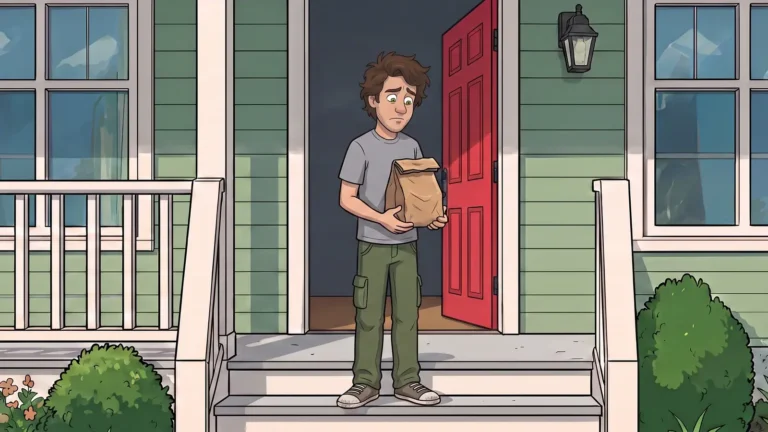
Will your grocery costs go down? Probably not, at least not the total at the register. Groceries cost about a third more than they did in 2019, and in more than half a century, grocery prices have fallen in only two years. So the relief won’t come from the shelf tags. It has to come from how we shop, and that part is more in our control than it feels right now.
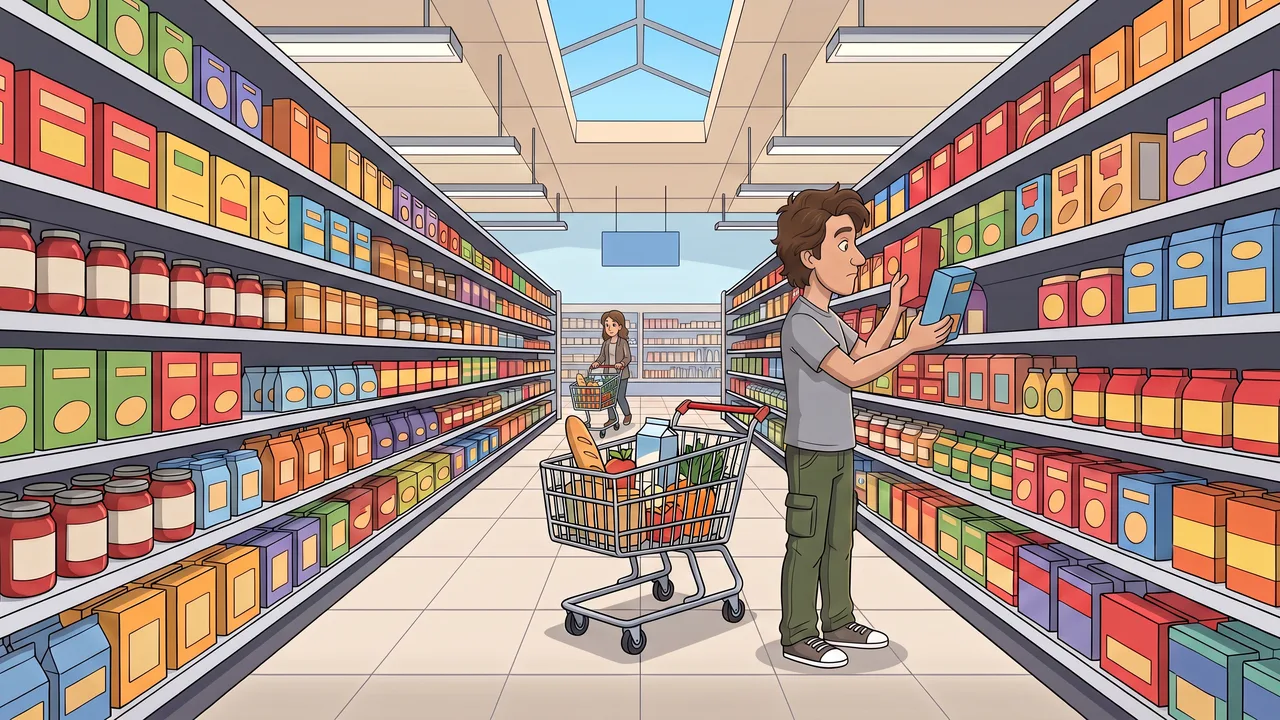
Here’s something to do on your next trip. Pick the three most expensive things you buy every week, and before each one goes in the cart, find the store-brand version and compare the unit price on the shelf tag. It’s the first step toward shopping the way stores quietly reward, which is what the rest of this post is about.
What’s in this post
- How much grocery prices have really gone up (and what our own cart shows)
- Why the total almost never comes back down
- Who really pays the regular price (and why your inflation may be higher than the news says)
- What higher grocery prices are doing to families
- How to pay less: six moves, biggest first
- Where the money goes next
Groceries cost about a third more than in 2019, and our cart is up even more
The official number is the place to start. Prices for food at home, meaning groceries rather than restaurant meals, are up about 32% since 2019, based on the government’s Consumer Price Index. Put simply, a grocery run that cost $100 in 2019 costs about $132 today.
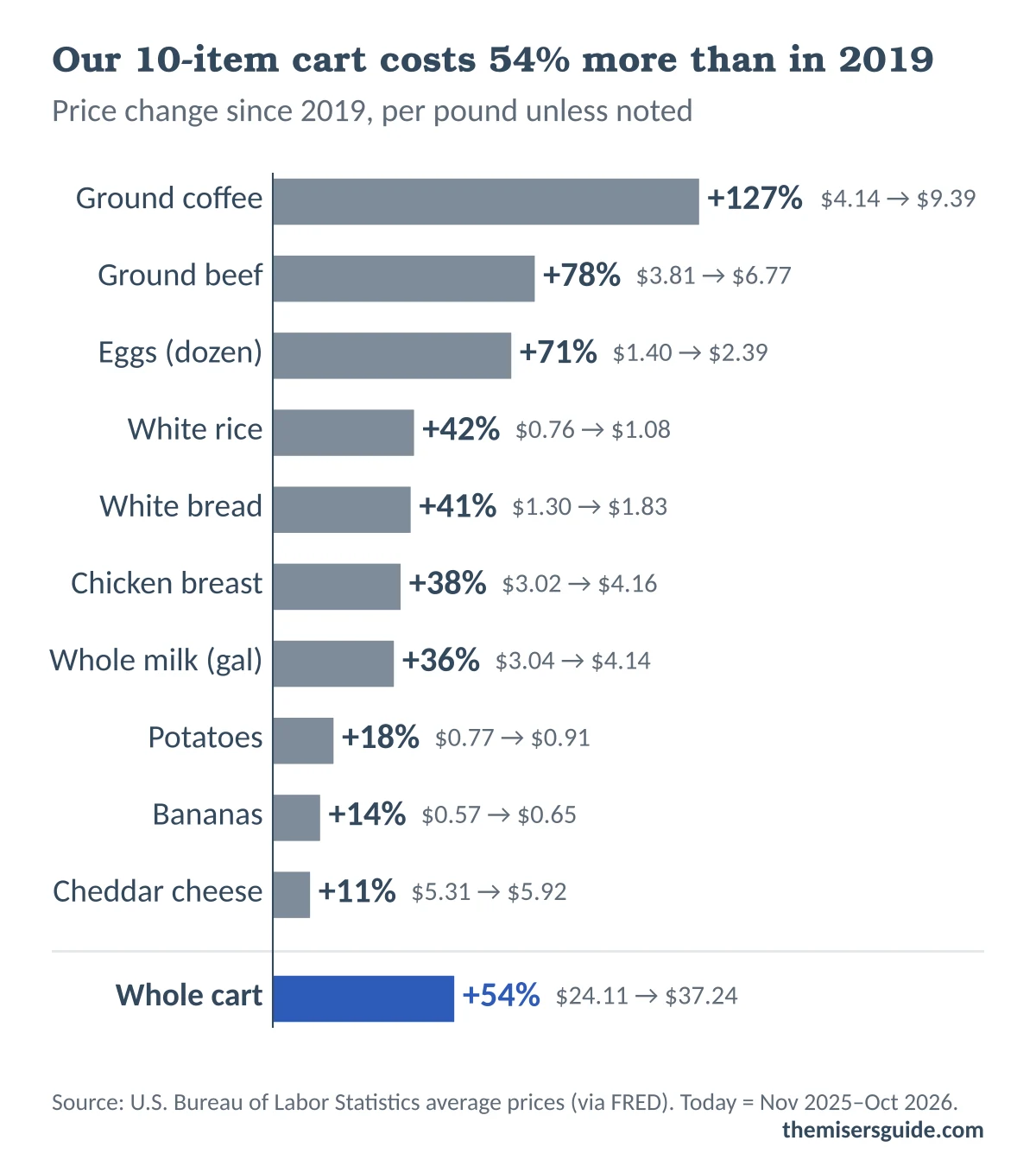
That number is an average of everything Americans buy, though, and nobody buys the average. To see what it looks like in a real cart, we priced 10 everyday staples using the government’s own average price data.
To keep this fair, we chose the list before we looked up a single price: 10 things that land in our own cart all the time. Only then did we check the numbers, so nobody could say we picked the scariest items off a price chart.
| Item | 2019 | Today | Change |
|---|---|---|---|
| Ground coffee, per lb | $4.14 | $9.39 | +127% |
| Ground beef, per lb | $3.81 | $6.77 | +78% |
| Eggs, Grade A large, dozen | $1.40 | $2.39 | +71% |
| White rice, per lb | $0.76 | $1.08 | +42% |
| White bread, per lb | $1.30 | $1.83 | +41% |
| Chicken breast, boneless, per lb | $3.02 | $4.16 | +38% |
| Whole milk, gallon | $3.04 | $4.14 | +36% |
| White potatoes, per lb | $0.77 | $0.91 | +18% |
| Bananas, per lb | $0.57 | $0.65 | +14% |
| Cheddar cheese, per lb | $5.31 | $5.92 | +11% |
| Total | $24.11 | $37.24 | +54% |
Our cart is up 54%, well ahead of the official 32%. Most of that gap comes from two items, coffee and ground beef. Take coffee out, and the rest of the cart is up about 40%.
Say you bought this exact cart every week for a year. In 2019, that came to about $1,254. Today it’s about $1,936, or $683 more for the same 10 things. Nobody buys the identical cart 52 weeks in a row, but it shows how fast a few dollars a week turns into real money.
The lesson isn’t that the official number is wrong. It’s that your own grocery inflation depends on what’s in your cart, and that turns out to be the key to paying less.
Don’t wait for the total to come down. It almost never does
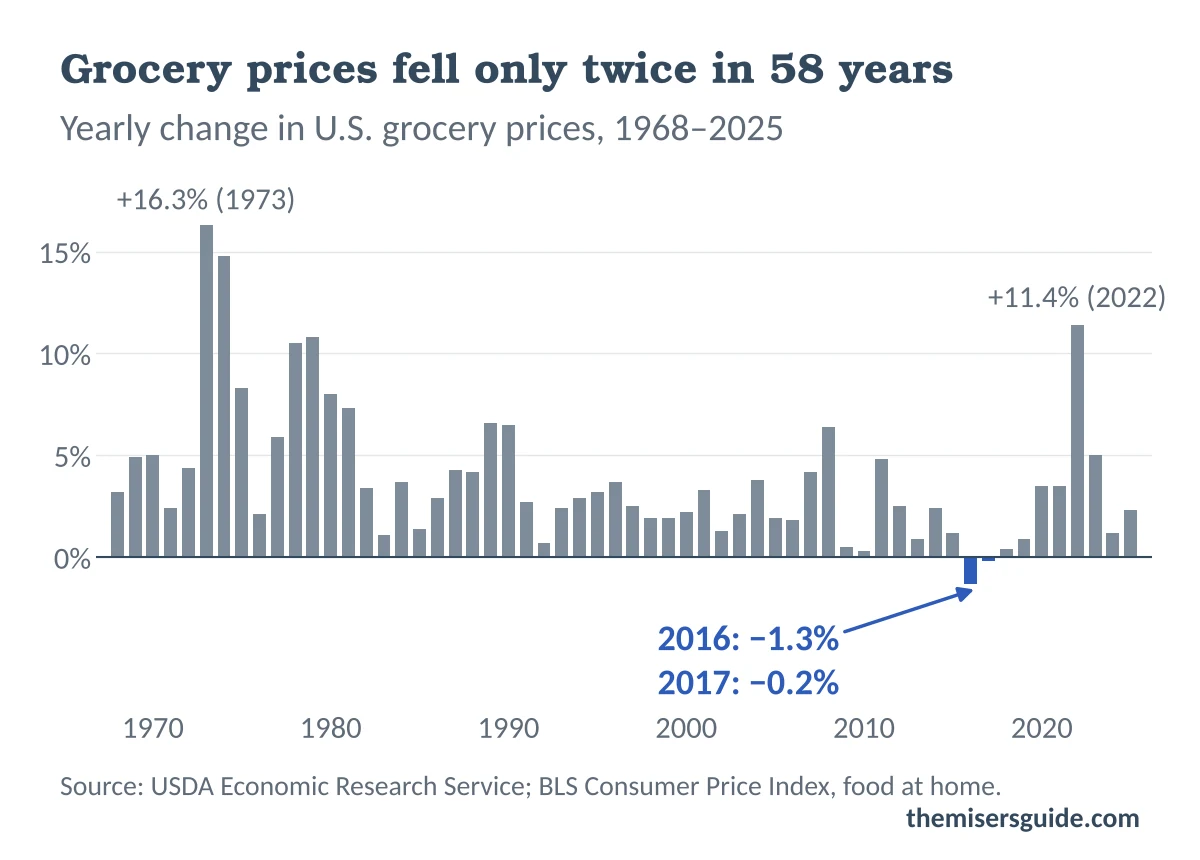
Prices on single items do fall. Eggs, for one, are cheaper than they were a year ago. But the total grocery bill rarely comes down. According to the USDA, grocery prices fell 1.3% in 2016, the first yearly drop since 1967, and slipped another 0.2% in 2017. Those are the only two dips in more than half a century.
Economists have a name for this pattern: rockets and feathers. Prices go up like a rocket and come down like a feather, if they come down at all. The phrase was coined to describe gas prices, but it’s now used for any price that rises fast and falls slowly, and grocery bills fit it well.
So if we’re going to pay less, it won’t be because prices went back to 2019. That’s not going to happen. It’ll be because we changed what goes in the cart and where we buy it. That isn’t a consolation prize, either. It turns out to be exactly how grocery pricing is built to work.
The regular price is for people who aren’t looking
Walk down almost any aisle and, if you know where to look, you’ll find the same quiet pattern: one brand on sale this week, a different one next week. That isn’t luck. Stores stagger sales on competing brands on purpose. In one aisle that economists tracked, frozen orange juice, at least one brand was on sale in about 88% of weeks.
Those economists, from Yale and the University of Chicago, found that stores price for two kinds of customers. “Loyals” grab the same brand every time and pay whatever the tag says. “Shoppers” switch brands and time their buys around the sales, and they pay well below the regular price. The store is happy to have both. The sale brings the shoppers in, and the regular price is mostly paid by people who aren’t looking.
Here’s the twist. The government’s inflation number assumes you’re one of the “shoppers.” Since 1999, its formula has assumed people shift toward items that got relatively cheaper, like moving to a cheaper kind of ground beef when one kind jumps. So if you’ve been a “loyal,” buying the same things every week whatever the tag says, your grocery inflation is probably higher than the 32% you hear on the news.
Being a loyal is a habit, though, not a requirement. Every move below is a way to switch sides of the price tag.
What higher grocery prices are doing to families
Before the moves, it’s worth pausing on how heavy this has gotten. More than 1 in 4 working-age adults put groceries on a credit card last year and couldn’t pay it off in full, according to a nonpartisan Urban Institute survey. About 1 in 5 paid for groceries with savings that were meant for something else, and the share who missed even the minimum payment on grocery charges has grown since 2023.
If that’s where you are, there’s nothing to be ashamed of. Food isn’t optional, and sometimes a card is the only way through the week. But grocery debt grows quietly, because the interest keeps running long after the food is gone. Paying less at the store is how that cycle starts to break.
If you’re struggling to keep food on the table right now, you don’t have to figure it out alone. Our financial crisis resources page lists places you can turn to for help.
How to pay less: six moves, biggest first
None of these takes hours of coupon clipping. They’re roughly in order of how much they can save, starting with the ones that change the price of your whole cart. For everyday tactics like unit pricing and shopping lists, our complete guide to saving at the grocery store covers the basics.
1. Buy your staples where the regular prices are lower
Where you shop is the biggest lever, because it changes the price of everything in your cart at once. When the nonprofit Consumers’ Checkbook priced the same 150-item list at stores around Washington, D.C., Aldi came in 36% below the average store, and Lidl 21% below. Its surveys in other cities keep finding the same pattern, with chains like Walmart, WinCo and Grocery Outlet often among the cheapest.
Even a smaller gap adds up. By Checkbook’s math, a family spending $250 a week saves about $1,300 a year at a store that’s 10% cheaper. You don’t have to switch completely, either. Buying your pantry staples at a low-cost store and the rest at your usual one gets you part of the savings without changing everything.
2. Make store brands your default, not your backup
When AARP priced 19 matching products in 2023 in three cities, store brands averaged 27% less than the name brands, though the gap varied a lot from item to item.
Here’s the part most shoppers don’t know: the store wants you to buy them. Grocers typically earn margins of 25% to 35% on national brands, but more than 40% on their own. So the store makes more on the cheaper product while you pay less. It’s one of the rare deals where both sides win, which is why nearly 1 in 4 grocery items sold in the U.S. is now a store brand.
Start where the brand rarely matters: rice, flour, sugar, canned goods, frozen vegetables and milk. If you try one and don’t like it, switch back on that item. You’re out a couple of dollars, and you’ve learned something.
Breakfast cereal is worth a try, too. In my family, Cocoa Dyno Bites, the budget version of Cocoa Pebbles, are a constant pantry staple (don’t judge me). But the generic version of Cinnamon Toast Crunch is nasty. “CTC” is perfect the way it is. Prove me wrong.
3. Swap across categories, not just brands
This is the switch the official inflation number doesn’t assume, and that’s exactly why it pays. Prices haven’t risen evenly. In our cart, ground beef is up 78% and coffee 127%, while chicken breast is up 38%.
Here’s a hypothetical. Say you buy two pounds of ground beef a week and swap one of them for boneless chicken breast. At today’s average prices, that’s $6.77 versus $4.16, or $2.61 saved every week. Over a year, that one swap is worth about $136. Dried beans, at about $1.68 a pound, can stretch a pot of chili or a pan of tacos further still.
You don’t have to give up the things you love. Look at your last few receipts for the items whose prices jumped the most, and ask what could stand in for them some of the time.
4. Stock up on staples when they hit their low price
Because stores rotate their sales, the shelf-stable things you buy most will usually come back around at a lower price. If you buy enough at that price to last until the next sale, you rarely pay the regular price at all. That’s what the “shoppers” in the Yale and Chicago study were doing.
To make it practical, watch the price of a few staples that keep well, like rice, pasta, canned goods, coffee and frozen meat. The lowest price you see over a couple of months is your stock-up price. When it comes around again, buy enough to carry you to the next one, as long as you have room to store it and you’ll use it before it expires.
Stocking up saves money in the long run, but it costs more on the day you do it, so start with one or two items if money’s tight this week.
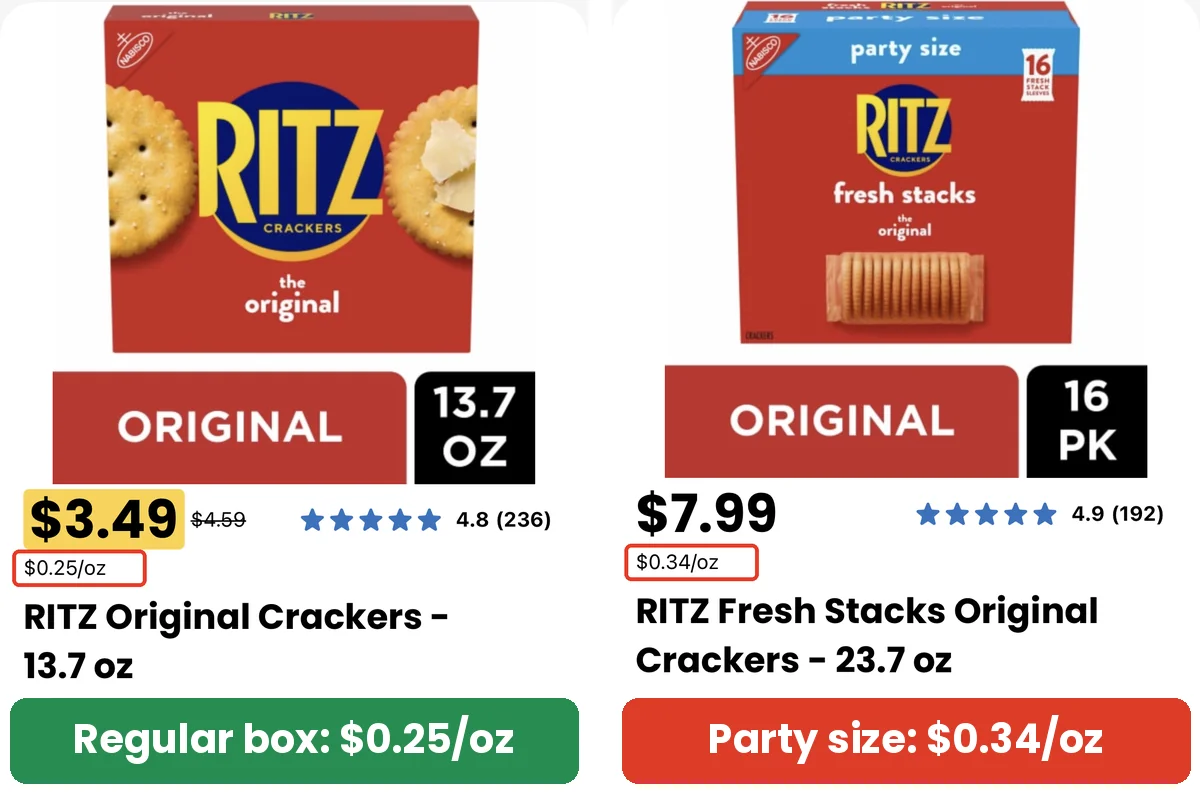
While you’re comparing, watch for shrinking packages. Shrinkflation is real, though the GAO found it explained only a sliver of the price increases from 2019 to 2024. The way to catch it is the unit price, the cost per ounce or per pound. Only nine states and D.C. require stores to post it, but many grocery stores show it on the shelf tag anyway. If yours doesn’t, divide the price by the ounces on the package with your phone’s calculator, and you’ll see which size is really the better deal.
5. Use store apps for what’s already on your list
Digital coupons and member prices in store apps can save real money. Just know that the app isn’t free, because the trade is your shopping data. A Consumer Reports investigation found that one of the country’s largest grocery chains builds detailed profiles of loyalty members, including an estimate of each shopper’s income, and that the offers can differ from one shopper to the next.
The personalized offers are designed to bring you back and grow your cart, and they work. Consultants at BCG say a strong personalization program typically raises a grocer’s revenue and profit by 3% to 5%. So the simple rule is to load coupons only for things already on your list. A discount on something you weren’t going to buy is still extra spending. Cashback apps work the same way, and our guide to cashback apps shows how to use them without overspending.
In my house we build our meal plan and shopping list first, then check for coupons or shopping app deals that cover those items. We ignore everything else. Alternatively, we’ll sometimes build our meal plan around the best coupons we receive. Either way works. Just be careful not to buy additional items simply because there’s a coupon.
6. Throw away less of what you buy
The EPA estimates that a household of four spends about $2,913 a year on food that never gets eaten, or roughly $56 a week. That’s more than four times the extra cost of our 10-item cart.
The fastest fix takes about ten minutes before you shop. Open the fridge, freezer and pantry, plan your next few dinners around what’s already there, and buy only what’s missing. Food that needs eating soon goes front and center, where you’ll see it.
Only buy what you know everyone in your household will eat. This is tricky for families with picky eaters, and it’s why we only buy generics that we actually like.
Name-brand Cinnamon Toast Crunch, while priced higher, is a better buy for my family than generic. It gets eaten (because it’s perfect), but the cheaper generic version gets thrown out (because it’s nasty). That’s money going right in the trash.
Where the money goes next
Say these moves trim $20 a week from your grocery spending, which is a hypothetical, but a realistic one. That’s $1,040 a year. If groceries have been going on a credit card, that money goes to the card first, because the interest there costs more than almost anything you could save. (If your balance hasn’t been budging, here’s why that happens.)
Once the card is paid down, the same $20 a week starts an emergency fund. That’s the cushion that keeps a surprise bill from sending next week’s groceries back onto a card.
Here’s where to start. Pull up your last grocery receipt and circle the three items that cost the most. Those three are where every move in this post pays off fastest: a store brand, a cheaper swap, a stock-up price. Pick one move for one of those items this week, and you’ve already started paying less than the price was designed for.
If you’re struggling to keep food on the table right now, you don’t have to figure it out alone. Our financial crisis resources page lists places you can turn to for help.
This content is for educational purposes only. It is not personalized financial advice. Consult a qualified financial advisor before making financial decisions.